
Representative content
Test the formats, vocabulary, quality and access patterns found in the intended environment.
Enterprise search guide
People rarely know the exact file name, folder or phrase they need. Enterprise search prepares content from approved sources and retrieves the material most likely to help, even when the question and the document use different words.
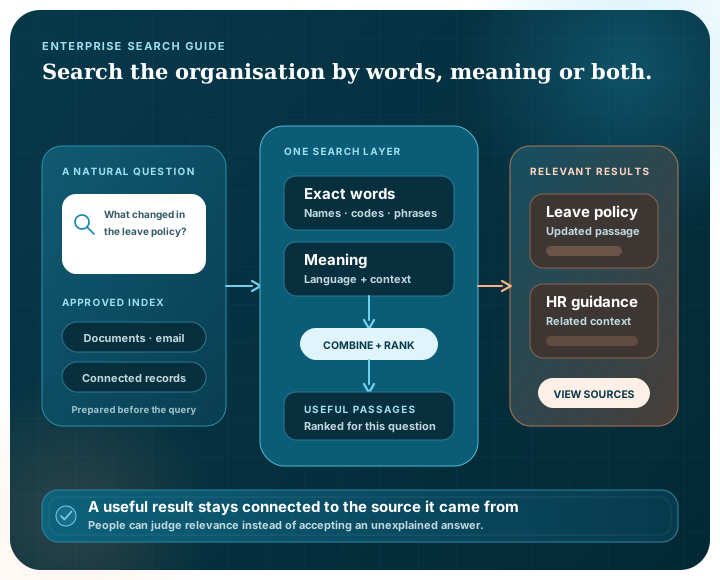
The basic process
Bring approved material from organisational sources into a form the search system can process.
Read supported formats, preserve useful context and associate the content with the correct collection or tenant.
Prepare keyword and semantic representations that can be searched efficiently.
Use the query and selected method to return the material most likely to help.
Show the result to a person or use it as context in an approved AI workflow.
Retrieval methods
| Method | Useful when | Limitation to test |
|---|---|---|
| Keyword search | Exact terms, names, codes and phrases matter | Relevant content may use different wording |
| Semantic search | Meaning is more important than exact wording | Near concepts still need useful ranking and boundaries |
| Hybrid search | Both meaning and exact language contribute to relevance | The blend needs tuning and representative testing |
Evaluation
Test the formats, vocabulary, quality and access patterns found in the intended environment.
Use a set of real questions and agreed relevance judgements rather than relying on an impressive demonstration alone.
Check that search and downstream workflows respect the access boundaries required by the organisation.
Treat outdated or conflicting knowledge as a governance issue, not something ranking can fully solve.
Review ingestion, monitoring, change, support and the ownership of each content connection.
Know what retrieved content can reach a model, person or external service at each step.
Enterprise search software helps authorised users find information across approved organisational sources. It typically processes content, builds searchable indexes and ranks results for a query.
AI enterprise search commonly uses semantic representations and language models to improve retrieval or prepare answers from retrieved context. The exact design and controls vary by product.
Retrieval-augmented generation first retrieves relevant information and then provides it as context to a generative model. Retrieval can reduce reliance on the model's general knowledge, but source quality and output review still matter.
No. Search can make content easier to find, but the organisation still owns source quality, access, currency, retention and permitted use.
Follow the product tour, or bring a few questions your current search struggles with to a private demonstration.