
Where will it run?
Choose the customer-controlled infrastructure and service shape that fit the operating environment.
For board members and enterprise leaders
For a board or leadership team, the important question is not which model is fashionable. It is what the system will do, what information it may use, where it will run and who remains responsible when a decision matters.
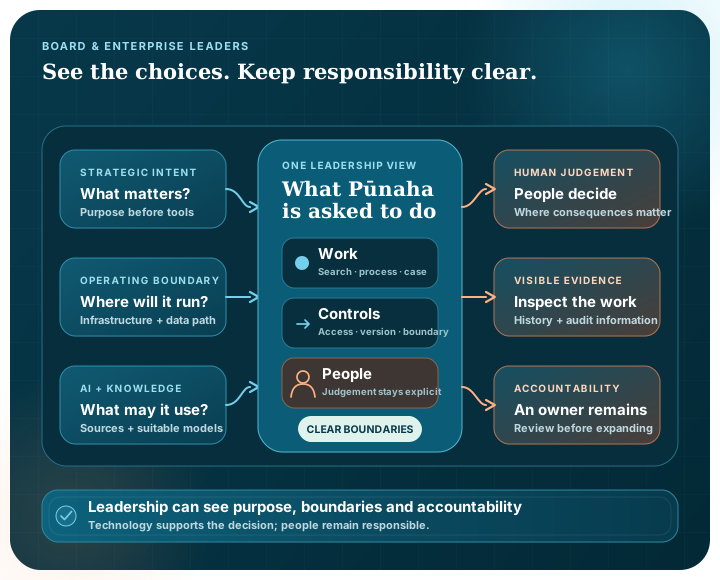
Questions worth asking
These questions bring the discussion back to the work, the people and the operating environment.
Choose the customer-controlled infrastructure and service shape that fit the operating environment.
Define the organisational sources that can support each search or workflow.
Control access to named knowledge, models, workflows, cases and connections, then review why that access still exists.
Explore access governanceUse supported local or external model deployments rather than treating one provider as the answer to every need.
Put approval into the workflow when consequences, policy or context require human judgement.
Use a repeatable process when the path is known and an adaptive case when evidence and judgement determine the next appropriate task.
Validate, version and publish workflows so operational change has a clear boundary.
Use audit information, application logs and workflow execution history as part of operational oversight.
A grounded starting point
Pūnaha is new. We do not have public customer case studies yet, and we will not fill that gap with invented results or return-on-investment figures.
Instead, start with a real knowledge or workflow problem. Describe what better would look like and agree how you would recognise it.
We can then shape a private demonstration around that process, giving your team something concrete to discuss before any wider decision.
Pick a process whose sources, decisions and participants can be clearly described.
Agree what relevance, control, usability and operational fit need to be demonstrated.
Use what is learned to shape the next decision rather than assuming scale from the outset.
Leadership view
| Area | Choice available | Leadership question |
|---|---|---|
| Deployment | Customer-controlled infrastructure | Where should the system and data path operate? |
| Models | Supported local and external providers | Which model is appropriate for each task? |
| Access | Named resources, exact actions and explainable reviews | Who should be able to use or administer each part of the system? |
| Processes | Visual workflows and BPMN-based process execution | Which work should follow a repeatable path? |
| Cases | CMMN-based adaptive planning, tasks and milestones | Which work must respond to evidence and professional judgement? |
| Oversight | Human approval, audit information and execution history | Where is accountability visible? |
Yes. Pūnaha is ready for product demonstrations and implementation conversations. Online purchasing and billing are not yet available.
No. Pūnaha is relevant to the insight engine market, but it is a new product and does not claim Gartner evaluation, recognition or validation.
Not yet. Pūnaha does not currently have public customer references, so this site explains capabilities and tours without presenting fictional customer evidence.
Use the product tour for an overview, then request a private demonstration focused on a real organisational search, process or adaptive case problem.
Tell us which knowledge problem, deployment choice or workflow your team needs to understand. We will use it to make the demonstration relevant.