
Case files
Define the information a case holds and keep runtime data attached to the case that produced it.
Adaptive case management
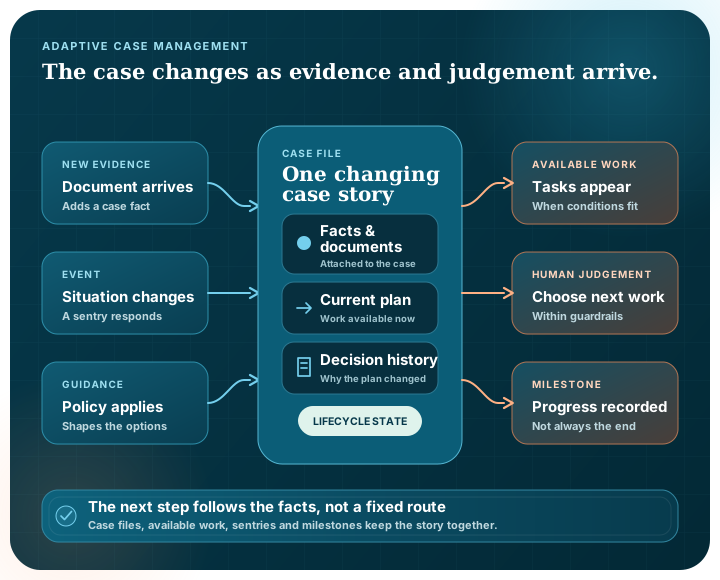
An investigation, complaint, claim or operational incident can change direction as new information arrives. Pūnaha keeps the case record, the available work and the decisions made along the way in one place, without forcing people through a sequence that no longer fits.
Why cases exist
A fixed workflow is useful when people already know the usual route. Case work is different. A new document may rule out one line of enquiry, an event may make another task urgent, or a specialist may decide that extra work is needed before the case can close.
Pūnaha gives that work a defined structure without pretending every valid route can be known in advance. The case type sets the boundaries. People work within those boundaries and the case keeps a record of what became available, what was chosen and what happened next.
A simple choice
| Question | BPMN-based process | CMMN-based case |
|---|---|---|
| Can we describe the normal route in advance? | Usually yes | Only partly |
| What drives the next step? | The process definition and current event | Evidence, events, rules and authorised judgement |
| Can people add appropriate work while it is running? | Only through modelled paths | Yes, from the choices allowed by the case plan |
| Typical examples | Onboarding, approvals and fulfilment | Investigations, incidents, complaints and complex assessments |
A case in practice
The exact route can change, but the case still has a clear beginning, current state and recorded outcome.
Start from a published case type and capture the information needed to begin.
Record documents, facts and events in the case file as they arrive.
Sentries and rules make work available when the right conditions are met.
Authorised people add suitable discretionary work and complete human, process or decision tasks.
Reach the required milestones and close, terminate or reopen the case according to its policy.
What Pūnaha provides
These are practical parts of the case model, not labels added to an ordinary task list.
Define the information a case holds and keep runtime data attached to the case that produced it.
Organise work into stages with human, process, decision and case tasks.
Make work available, start it or stop it when an event and its conditions are satisfied.
Mark meaningful progress without treating every milestone as the end of the case.
Offer authorised people a controlled set of discretionary work that can be added when it applies.
Retain the state of the case and its plan items so work can continue beyond one browser session.
Use the models together
Adaptive does not have to mean manual.
A case worker may need judgement to choose the next step, while the selected step itself follows a well-understood process. Pūnaha can invoke a published process from the case instead of asking someone to repeat those steps by hand.
The same applies to decisions. A decision task can apply defined rules and return the result to the case. The person working the case can then consider that result with the rest of the evidence.
Holds the changing situation and the choices available now.
Runs repeatable work with explicit events, activities and routing.
Applies defined rules to known inputs and returns a result.
CMMN support
Pūnaha supports a defined CMMN 1.1 model and diagram scope.
You can design case types visually, validate supported CMMN and CMMNDI XML, preview an import before creating a draft, and export supported case and diagram information. External process, decision and case references still need to be mapped to resources in the target environment.
We do not claim formal CMMN conformance or certification. That would require independent notation review and interoperability evidence from external CMMN tools for the release being assessed.
Case files, stages, plan items, sentries, planning, lifecycle, validation and supported import and export.
Automated unit and browser-to-database coverage for the behaviours Pūnaha controls.
Formal conformance or complete interoperability with every external product.
Use a workflow when the route is substantially repeatable. Use a case when authorised people must decide what work is appropriate as evidence and circumstances change.
Yes. A process task can invoke published repeatable work, and a decision task can invoke defined decision logic.
Yes. An authorised planner can add an applicable discretionary item from a published planning table. The choice and resulting state remain part of the case record.
Yes, within the supported CMMN 1.1 model and diagram scope. Pūnaha validates the source, previews its projection and reports mappings or warnings that need review.
No. The current public description is CMMN-based adaptive case management. No certification or formal conformance claim is made.
We can work through its information, roles, milestones, repeatable tasks and the choices people need to make as it develops.